
1. Background and Objective
A common requirement in portfolio and program management is the need to manage dependencies between tasks in otherwise separate projects, referred to as Inter-Project Dependency Management (as distinct from Intra-Project Dependency Management, which manages dependencies between tasks within a single project).
The project with tasks dependent on deliverables from another project is referred to as the downstream project, while the project responsible for providing the deliverable, or “resolving the dependency”, is referred to as the upstream project.
The overall objectives of Inter-Project Dependency Management are to:
- Prevent delays to the critical path and key milestones of the downstream project
- Minimise additional effort required from both the downstream and upstream projects
Some programs encounter this requirement, specifically where critical path tasks depend on deliverables from projects external to the program (referred to collectively herein as boundary projects).
The purpose of this document is to describe the method by which these dependencies are managed in order to protect the program's critical path, without introducing unnecessary or duplicated effort for either the program or boundary project teams.
2. Practice Definition: Inter-Project Dependency Management
The Program Management Office (PMO) will initially identify dependencies with upstream boundary projects and include the resulting milestone list in the appropriate location within the program’s integrated workplan.
Only material dependencies - those with a significant schedule impact - should be captured, and only at WBS level 1 or 2. Capturing WBS level 3 or lower from boundary projects in the integrated workplan would create unnecessary administrative effort.
PMO will utilize other personnel to support this identification, including boundary project managers (PMs), leadership, and PMO teams.
PMO will:
- Identify and document in the integrated plan any material dependencies on upstream boundary projects, including the date by which the dependency must be satisfied and any critical path impact if the dependency is not realized.
- Agree on the dependency, delivery date, and critical path impact with upstream PMs, PMO, and leadership, as appropriate.
- For dependencies with a Medium or High critical path impact, enter and track them as a WBS level 1 or 2 milestone in the integrated program workplan.
- Obtain periodic updates from upstream PMs on progress toward meeting dependency delivery dates.
The frequency of updates will depend on:
1. Critical path impact (Higher impact requiring more frequent updates, typically weekly)
2. Proximity to the Delivery date (with frequency increasing as the Delivery Date approaches). - Ensure that updates include:
1. Forecasted delivery date compared to baseline delivery date
2. Clearly highlighted forecasted delays
3. Recommended recovery actions to prevent delays
Note: The project management methods and tools used by the boundary projects should properly be considered a black box, as long as they reliably meet these information requirements. - In the case of forecasted delays, raise a formal risk with probability and impact reflecting the critical path impact.
- As the impacted entity, the program owns the risk. Specifically, the impacted workstream lead(s) act as risk owners, and relevant PM/workstream leads from the upstream project are the risk participants.
The RACI is as follows:- The program is accountable for the risk, and in some cases, jointly responsible if mitigation actions require its participation.
- The boundary project is responsible (for executing required mitigation actions) and consulted.
- Program and boundary project leadership are informed, as appropriate.
- Direct the relevant parties to resolve the risk using standard risk management practices (e.g. conducting a risk workshop to determine mitigations, which are then implemented by the agreed due date.)
- Importantly, define and direct the risk management process but does not execute it, in line with the principle “PMO defines, project teams execute”.
- In determining appropriate mitigations, ensure that all relevant parties consider options beyond adding extra resources, increasing working hours, and/or delaying milestones.
This approach minimizes effort by not requiring a regular “dependency management” meeting involving large numbers of upstream and downstream project members. Dependency reporting, as described above, identifies risks to the program's critical path while involving only the personnel directly required for mitigate.
It also minimizes effort by eliminating the need for upstream and downstream teams to modify or have visibility of each other’s detailed workplans.
3. Practical Application: Dependency Structuring and Tracking Model
To complement the Inter-Project Dependency Management approach described above, the following model provides a practical structure for representing, tracking, and coordinating dependencies across upstream and downstream projects.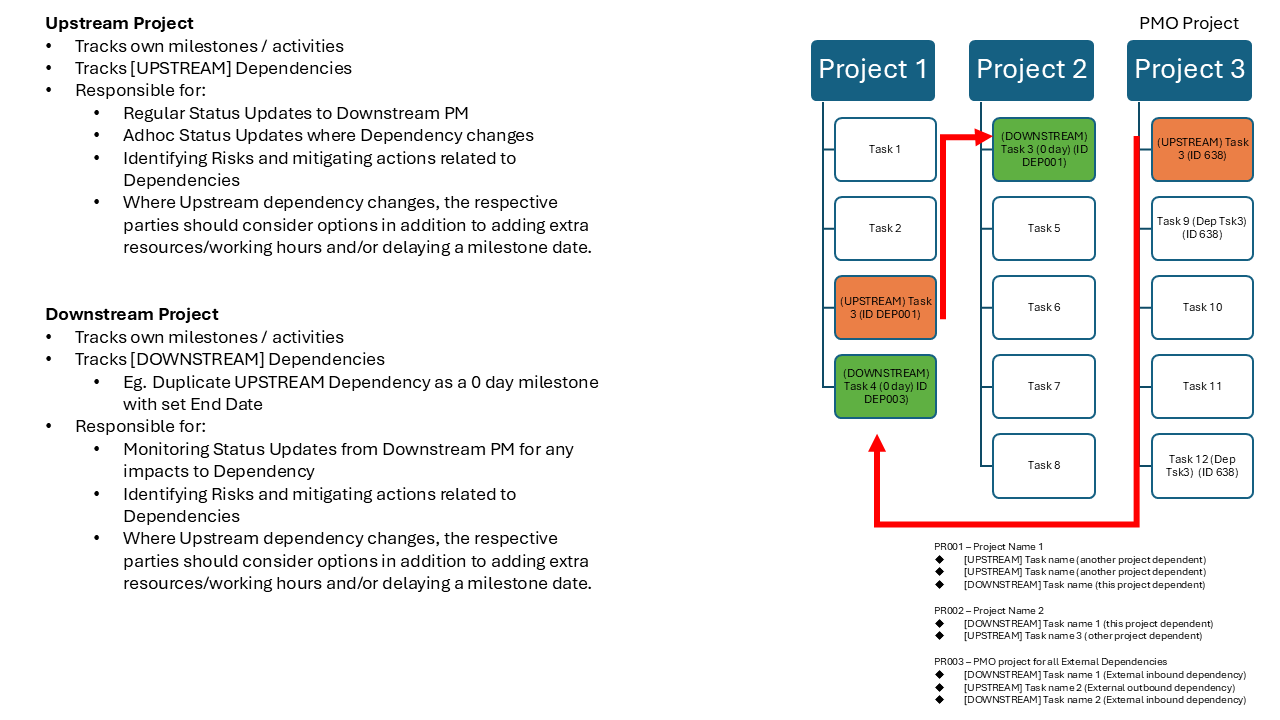
1. Dependency Classification and Representation
Within the integrated program structure, dependencies should be clearly classified and labeled as:
- [UPSTREAM] dependencies – deliverables that must be provided by another project
- [DOWNSTREAM] dependencies – deliverables this project must provide to others
Each project within the program should explicitly identify both types within its workplan.
Additionally:
- Dependencies should be uniquely identified (e.g., Dependency IDs such as DEP001) to enable traceability across projects.
- Downstream dependencies can be represented as 0-day milestones with fixed end dates, ensuring visibility without duplicating detailed upstream activities.
This approach reinforces the principle of capturing dependencies at a high level while ensuring alignment across projects.
2. Centralised Visibility of External Dependencies
For programs with multiple external (“boundary”) dependencies, it is recommended to maintain a dedicated consolidation layer, such as:
- A central PMO-owned project or workstream that aggregates all external dependencies
- Separate tracking of:
- Inbound (downstream) dependencies – deliverables required from external projects
- Outbound (upstream) dependencies – deliverables provided to external projects
This structure enables:
- A single source of truth for cross-boundary dependencies
- Improved visibility of systemic risks across the program
- Reduced duplication of tracking across individual projects
3. Roles and Responsibilities in Practice
Upstream Project Responsibilities
- Tracks its own milestones and activities independently
- Tracks all [UPSTREAM] dependencies it is responsible for delivering
- Provides regular status updates to downstream PMs and ad hoc updates where dependency status changes
- Identifies risks and executes mitigation actions related to dependencies
Downstream Project Responsibilities
- Tracks its own milestones and activities independently
- Tracks all [DOWNSTREAM] dependencies it relies on
- Reflects upstream deliverables as milestones (e.g., 0-day milestones) in its plan
- Monitors updates from upstream projects and assesses impacts
- Identifies and participates in mitigation of dependency-related risks
4. Coordinated Risk and Mitigation Approach
Consistent with the overall PMO framework.
Both upstream and downstream parties share responsibility for identifying and addressing dependency risks.
This reinforces a collaborative and solution-oriented approach to dependency management.
5. Key Integration Principles
This model aligns with and reinforces the core principles defined earlier:
- No duplication of detailed workplans between projects
- Clear ownership of deliverables (upstream vs downstream)
- Minimal administrative overhead through high-level tracking
- Outcome-focused coordination, not process alignment
By combining structured dependency representation with the “black box” principle, programs can maintain clarity, accountability, and efficiency while protecting critical path outcomes.